- +91 9511117684
- shweta@dataman.in
Apparel Inventory Management Software: Boost Efficiency & Maximize Profits

Table of Contents
Post Views: 453
In today’s fashion world, running a business means doing far more than just tracking inventory; it now requires having complete real-time visibility to order, predictive forecasting, and making sound data-based decisions. Today, customers have higher expectations than ever; fashion/seasonal trends change quickly; and with omnichannel sales, there is an additional complication to what’s already a complicated task. You can’t just rely on traditional spreadsheets or counting physical inventory by hand anymore.
Modern apparel brands are now investing in a complete fashion inventory software that offers real-time visibility across stores, warehouses, and online platforms. An advanced Apparel inventory management Software allows retailers to manage complex SKU combinations, automate stock control, and improve inventory accuracy.

What Is Apparel Inventory Management Software?
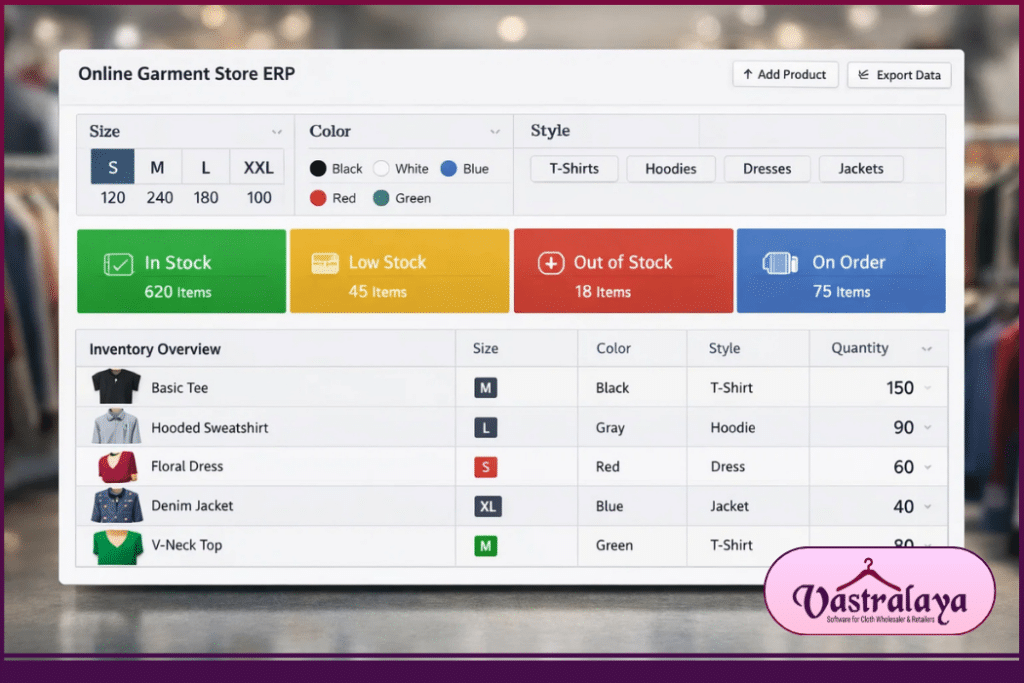
An advanced garment ERP software or apparel stock tracking software is designed to help retailers manage sizes, colors, and style variations efficiently across all sales channels.
Key functionalities include:
- Keep a constant watch on how much product is in stock, shipped, and on hand across all sales channels (in-store, warehouse, and online) in real time.
- Manage by size, color, style, and variant with efficiency.
- Eliminate human error and automate inventory ordering based on sales vs. on-hand quantity.
- Use historical sales data as well as sales trends to estimate what products will be sold to make sure you have enough to meet customer requests.
- Use point-of-sale (POS) and e-commerce to provide an integrated inventory order management system.
This software is like the central nervous system of your apparel business unit, making sure that inventory is available when and where it is needed.
Why Apparel Businesses Need This Software
The unpredictability of fashion retail is due to many factors, such as overnight shifts in trends, customers demanding immediate access to products, and thousands of SKU combinations across size, color, and style, making retail inventory management for apparel require automation, precision, and centralized control.
Key Benefits of Apparel Inventory Management Software
| Benefit | How It Helps Your Business |
|---|---|
| In-Stock Real-Time Monitor | Prevent out-of-stock and/overtime selling in every channel. |
| Demand Forecasting | Plan your stock by accurately evaluating your sales trends. |
| Multi-Location Management | Using multi-store inventory software, you can manage warehouses, physical stores, and online inventory through the same management system. |
| Stock auto replenishment | Retail inventory automation software reduces manual errors and automates stock replenishment based on real-time sales data. |
| Reporting and Analysis | Evaluation of which items are hot sellers versus those that are slow sellers. |
| Point of Sale (POS) & E-commerce Integration | Identifying and maintaining consistent levels of stock visibility throughout every sales channel. |
The above advantages lead to a more efficient way to do business, which means lower costs, faster order fulfillment times, and better customer service – All important elements when trying to succeed in the highly competitive world of apparel retailers.
Common Challenges in Apparel Inventory Management Software
The complexities of fashion inventory management are equivalent to those of other retail classifications, but an organized and managed inventory system can manage situations and eliminate issues for retailers.
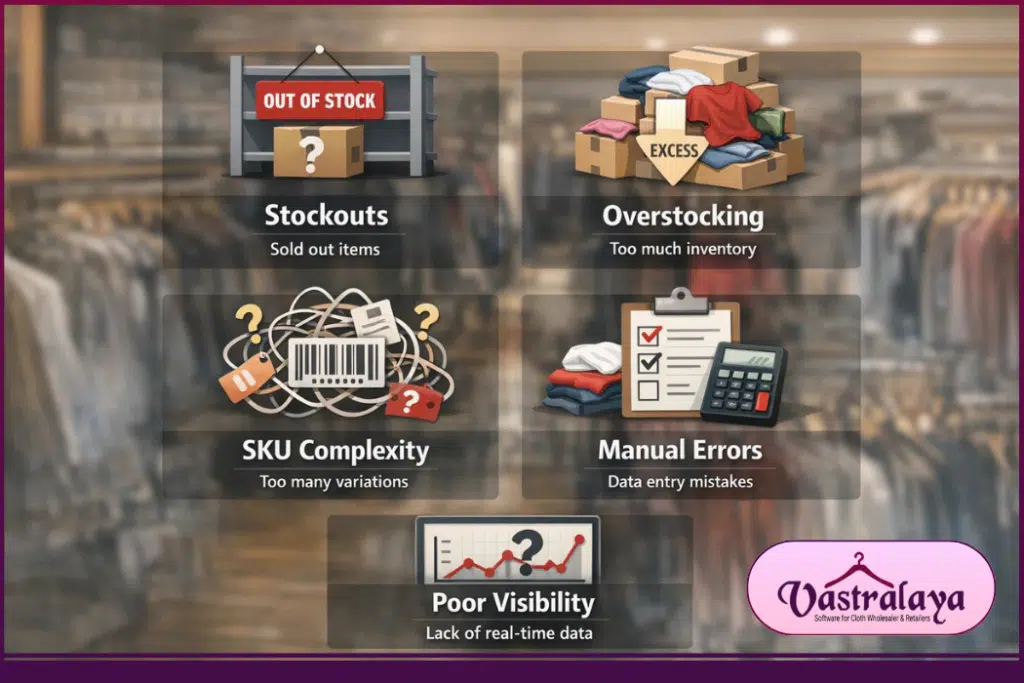
1. Stockouts During Peak Seasons
Without proper apparel stock tracking software, businesses risk overstocking slow-moving items or facing stockouts during peak seasons.
2. Overstocking Slow-Moving SKUs
Fashion trends change rapidly. If inventory planning is based on guesswork instead of real-time data, brands may end up overstocking items that become outdated, leading to heavy discounting and reduced profit margins.
3. SKU Complexity (Size × Color × Style)
Apparel retailers deal with thousands of SKU combinations. Managing variations across sizes, colors, fits, and styles manually increases the chances of miscounts and inventory mismatches.
4. Manual Errors & Data Inaccuracy
Relying on spreadsheets or physical stock counts often leads to data entry mistakes, duplication errors, and delayed updates. Even small inaccuracies can disrupt the entire supply chain.
5. Poor Multi-Location Visibility
For businesses operating multiple stores, warehouses, or online channels, a lack of centralized visibility makes it difficult to track stock levels in real time. This often results in overselling or inefficient stock transfers.
These challenges highlight why investing in a modern Apparel Inventory Management ERP is no longer optional but essential for sustainable growth.
Recommended reading: How Apparel Financial Accounting Software Improves Cash Flow and Control
Market Trends & Insights
The demand for Apparel Inventory Management Software is growing rapidly. Retailers now need more than just stock tracking; they require real-time visibility, predictive forecasting, and multi-channel integration. Modern technology makes this possible, helping apparel businesses stay competitive in a fast-changing market.
Here are the key trends shaping the industry:
1. Rapid Market Growth
The global inventory management software market is expanding fast. According to Grand View Research, it is expected to reach USD 7.14 billion by 2033. Growth is driven by:
- Automation of inventory processes
- Cloud adoption for flexible operations
- Real-time visibility across stores and warehouses
2. Cloud-Based Solutions
Cloud inventory systems are now standard for apparel retailers. They allow:
- Access from anywhere, anytime
- Seamless syncing across multiple locations
- Easier management of both online and offline stores
These systems reduce infrastructure costs and increase operational flexibility.
3. AI & Predictive Analytics
AI-powered forecasting is transforming inventory management. Deloitte’s 2026 Retail Industry Outlook reports that retailers using AI can:
- Reduce stockouts by up to 65%
- Lower inventory errors by 20–50%
- Make faster, data-driven decision
AI ensures retailers maintain the right stock at the right time.
4. Omnichannel & E-Commerce Growth
Global e-commerce continues to grow, increasing pressure on inventory systems to be accurate and real-time. Modern apparel brands need solutions that:
- Sync stock across online marketplaces, e-commerce sites, and physical stores
- Avoid overselling or stockouts
- Support fast fulfillment
Key Features to Look For In Apparel Management Software
When selecting Apparel Inventory Management Software, businesses should focus on features that enhance accuracy, automation, real-time visibility, and multi-channel control.
1. Inventory Tracking & Control
Track all product attributes – such as size/colour/style/SKU combinations – to minimize instances of being out-of-stock and/or in excess of stock.
2. Demand Forecasting
In addition to checking sales history and trends, assess current stock levels to project future requirements and reduce dead stock, resulting in increased liquidity.
3. Omnichannel Integration
A powerful omnichannel inventory software ensures that stock levels remain synchronized across physical stores, e-commerce platforms, and online marketplaces, preventing overselling and improving customer trust.
4. Automated Replenishment
Set order timing to automatically generate purchase orders and to minimise manual errors.
5. Reporting & Analytics
Utilise reports to identify slow-moving stock, highest-selling SKUs, and highest profits, to help you with better purchasing decisions.
How Inventory Software Transforms Operations

Eliminates Stock Errors
The possibility of a manual count error is very high. When automated scanning technology provides a real-time count, the number of errors is reduced dramatically.
Improves Cash Flow
You can avoid overstocking and stockouts, which will free up capital for strategic investment.
Optimizes Warehouse Efficiency
You can simplify the processes of picking, packing, and dispatching to reduce operating costs and decrease delivery times.
Supports Scalability
You can add more stores or products to new regions without changing your inventory system.
Traditional vs. Software-Driven Inventory
A modern inventory management ERP for apparel industry offers capabilities far beyond traditional methods.
| Features | Traditional Method | Inventory Software |
|---|---|---|
| Real-Time Updates | No | Yes |
| Error Rates | high | Low |
| Multi-Channel Sync | Manual | Automatic |
| Forecasting | Intuition | AI driven |
| Efficiency | Low | High |
| Scalability | Hard | Easy |
Practical Use Cases of Apparel Inventory Management Software
Apparel Inventory Management Software plays a critical role across different segments of the fashion industry, from retail brands to e-commerce sellers and multi-warehouse distributors.
- Retail Fashion Brands: Retail brands benefit from fashion inventory software to manage size, color, and style combinations efficiently.
- E-Commerce Sellers: Create and maintain the same inventory across all websites and marketplaces so that each store displays accurate availability.
- Multi-Warehouse Operations: Multi-store inventory software ensures accurate stock distribution across all warehouses based on regional demand.
Best Practices for Implementation

- Start with the correct stock numbers.
- Adjust your restock point depending on how fast items sell via specific SKUs.
- Provide your staff with the training needed to scan and use real-time data.
- Integrate your systems across POS and eCommerce experiences.
- Monitor weekly to make changes to forecasts by looking at dashboards/Analytics.
Conclusion
The Apparel Inventory Management Software has transitioned to an essential component of operational efficiency, profitability, and customer satisfaction. Apparel Manufacturers now use technology to make smarter/faster/more profitable decisions through the usage of real-time tracking,automatic replenishment, demand forecasting, and integrated multi-channel approaches to inventory control.
Businesses that implement an integrated inventory management ERP for the apparel industry gain better forecasting accuracy, improved stock turnover, and long-term scalability. In a market where trends change quickly, SKU variations are high, and customers demand fast fulfillment, the right inventory software can make all the difference.
Investing in a robust garment ERP software or clothing inventory management system is an investment in growth, scalability, and long-term success.
“See how our Apparel Inventory Management Software can streamline your operations and boost profits. Book a free demo now!”
FAQ
1. What is apparel inventory management software?
A software system designed to track stock, automate replenishment, forecast demand, and integrate inventory across POS and e-commerce channels.
2. How does AI help in inventory forecasting?
AI analyzes sales trends to predict future demand, reducing overstock and stockouts.
3. Why choose cloud-based inventory software?
Cloud solutions offer scalability, real-time updates, remote access, and automatic updates — ideal for growing apparel businesses.
4. Can it integrate with e-commerce platforms?
Yes, it can sync inventory with platforms like Shopify, Amazon, and other marketplaces for consistent stock levels.
5. What ROI can apparel businesses expect?
Reduced inventory costs, improved turnover, fewer stockouts, and increased customer satisfaction, leading to higher profitability.
0
 25/16 Karachi Khana, Kanpur