- +91 9511117684
- shweta@dataman.in
How Food Industry Accounting Software Is Transforming Financial Management in the Food Sector
Table of Contents
Post Views: 1,576
Managing your money within today’s food sector requires not only keeping track of your accounts but also the ability to survive, expand, and ultimately make sound decisions. In addition, if you are in the market for food industry accounting software, you likely want a reliable way to track and manage inventory, control food costs, maintain tax compliance, and increase profit without relying on spreadsheets.
This is why food sector-specific accounting software is critical. In this article, we are going to provide a complete overview of food sector accounting software in an easy-to-understand format, and also explain why this accounting software is a necessity in 2026, as well as how it enables the sustainable growth of food businesses.
Why Food Industry Accounting Software Is Essential for Food Businesses in 2026

Profit margins in the food industry are not particularly high. A minor error in either tax calculation or product tracking can significantly impact a business’s entire profit margin.
The complexity involved with the food industry and its businesses, such as food/products being perishable, numerous pricing levels for raw materials, costing recipes down to each ingredient, and compliance requirements, are far too complex for non-food-specific accounting software to handle.
Food software provides unique solutions to these challenges, providing real-time visibility into how the business generates revenue and where revenue is lost via integration of the full supply chain.
What Is Food Industry Accounting Software for Food & Beverage Businesses?
Food sector accounting software is designed specifically for all food operations: restaurants, food manufacturers, cloud kitchens (ghost kitchens), bakeries, distributors, and food processing facilities and is more than a simple bookkeeping program.
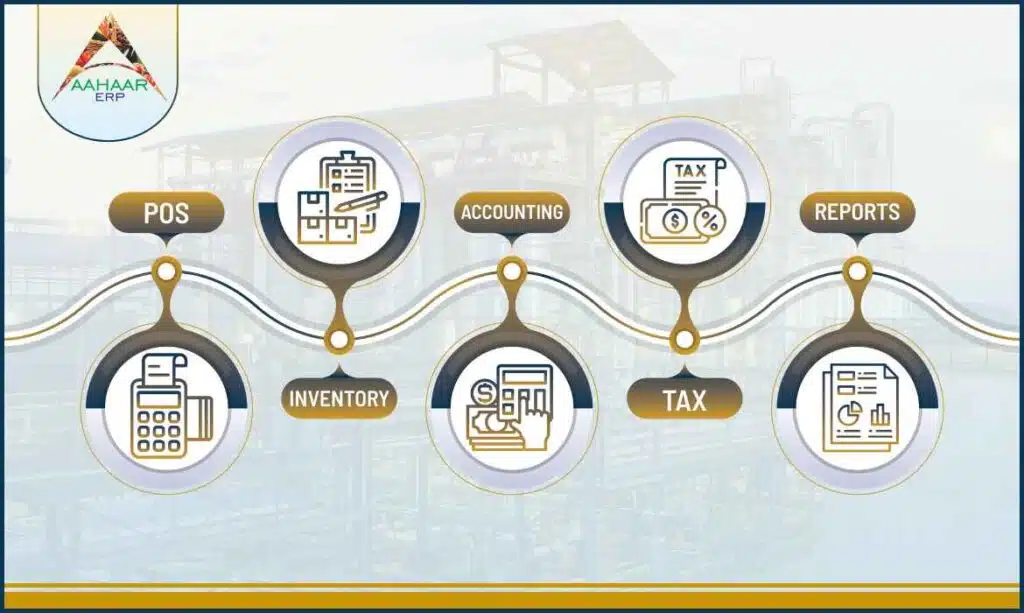
Through integrating the functionality of accounting software with production, procurement, inventory management, and point of sale (POS)systems, food industry accounting software is enhanced beyond traditional bookkeeping.
Examples of common needs that are only available through a specific accounting software include:
- Tracking the expiration date and perishable inventory of food products.
- Calculating and tracking food costs by batch through recipe management.
- Establishing and complying with tax system requirements specific to the food industry.
- Reconciling daily sales into a balancing accounting record.
- Monitoring price fluctuations for raw materials and vendors supporting your business.
Therefore, food software provides food companies with greater accuracy, value, and return on investment than general accounting programs.
Latest Market Insights & Data for Food Accounting Software
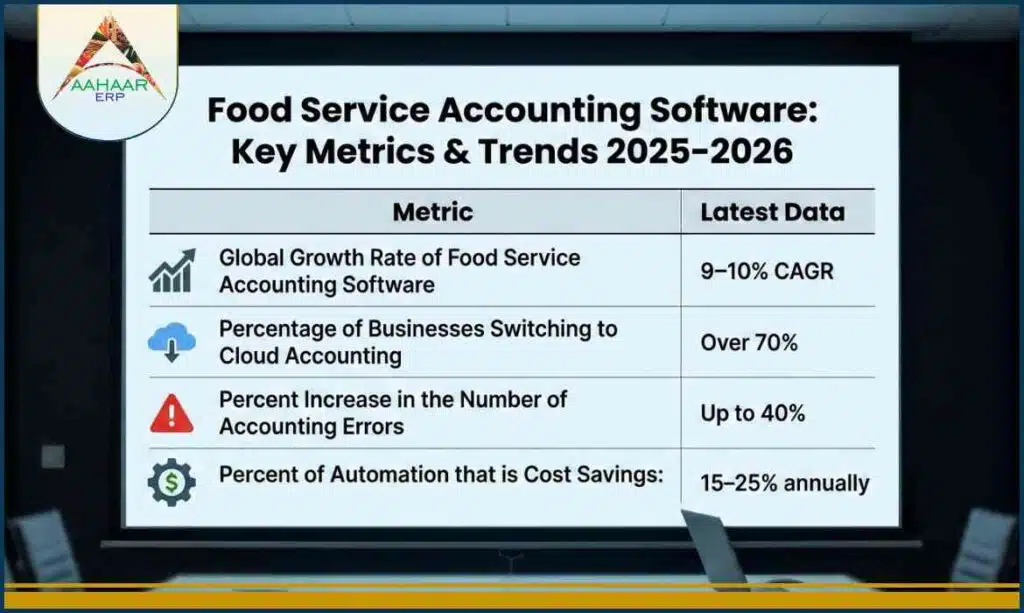
Increased complexity of operations and digital changes are the driving forces behind continued growth in food and beverage accounting software.
| Metric | Latest Data |
|---|---|
| Global Growth Rate of Food Service Accounting Software | 9–10% CAGR |
| Percentage of Businesses Switching to Cloud Accounting | Over 70% |
| Percent Increase in the Number of Accounting Errors | Up to 40% |
| Percent of Automation that is Cost Savings | 15–25% annually |
source
The mentioned statistics demonstrate a commonality: Businesses within the food and beverage industry that utilize food specific accounting software demonstrate better long-term financial stability and cost control.
Key Benefits of Food Industry Accounting Software for Cost Control & Growth
With the right accounting system, food businesses can effectively manage their costs, reduce errors, and create successful financial models and analyses.
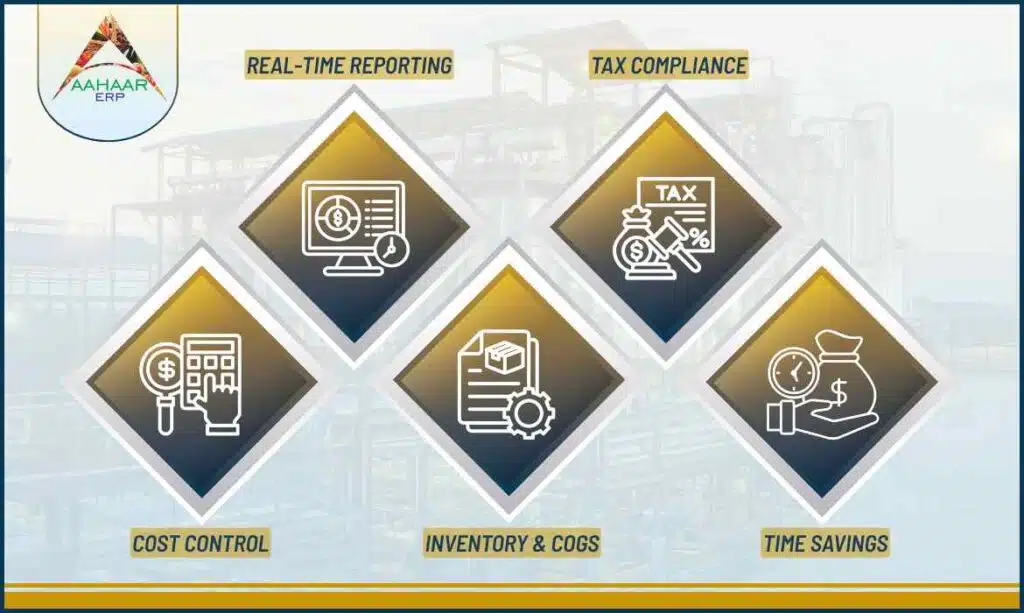
1. Better Monitoring of Food Costs & Food Margins With Accurate Product Pricing
The costs of raw materials fluctuate regularly. Foodservice accounting software is used to connect every single food item, recipe, or batch of production directly to the financial records, allowing companies to know exactly how much it costs to produce a product and create a correct margin analysis.
2. An Immediate and Transparent Financial Picture
Rather than waiting for a month-end report and only receiving partial views of your business, Business Owners can now view these real-time dashboards to check what sales are happening, what expenses have occurred, and what their profitability is.
3. Cost of Goods Sold Accounting Associated With Inventory
With all of your inventory being directly connected to COGS (Cost of Goods Sold) accounting when it is physically delivered into your kitchen or received in your warehouse, you have an accurate means of determining the precise amount of waste and/or overstock you have in your business.
4. Ease in Tax Compliance
Foodservice Industry businesses face the complexities of an elaborate tax system. Accounting Systems provide businesses with the ability to automate calculations, ease audits, and reduce tax compliance risks.
5. Economy of Time and Money
Saving hours each week eliminates the manual entry of information into accounting systems, therefore allowing the foodservice teams to utilize that time towards better operational efficiencies, versus correcting mistakes.
Core Features to Look For
| Feature | Why It Matters |
|---|---|
| General Ledger Automation | Speeds up reporting while reducing manual input errors |
| Inventory Integration | Keeps track of expenses and perishable goods |
| Payroll & Labor Expense | Manages changing employee costs efficiently |
| Tax & Compliance Tools | Ensures accurate and timely filing |
| Cloud Access | Access data anytime, anywhere with secure cloud storage |
| Multi-Facility Management | Centralized control across multiple restaurant locations |
| AI-Driven Reports | Predicts sales trends and cash flow accurately |
Who Should Use Food Industry Accounting Software?
This software is ideal for:

- Restaurant and Café Operations
- Food Manufacturer’s Operations
- QSR Chain Operations and Cloud Kitchen Operations
- Dessert Brands, Bakeries, and Confectioneries
- Food Wholesale and Distribution
Food accounting software can provide the right software solution for all scales and complexities of Food establishments, whether you have one location or multiple locations.
Food Industry Accounting Software vs Generic Accounting Tools
| Aspect | Food Industry Accounting Software | Generic Accounting Software |
|---|---|---|
| Recipe & Batch Costing | Yes | No |
| Perishable Inventory Tracking | Yes | Limited |
| POS & Inventory Integration | Seamless | Partial |
| Food-Specific Tax Handling | Built-in | Manual |
| Profitability Analysis | Detailed | Basic |
This comparison demonstrates why industry-specific solutions work better for food firms than general technologies.
How Food and Beverage Software Supports Business Growth
The technical and financial complexity associated with food-producing and manufacturing firms grows rapidly as those firms expand in both size and physical presence (many of which have multiple locations/warehouses).
Therefore, the right software platform can enable a food firm’s growth by providing tools for:
1. Managing Multiple Locations/Warehouses
2. Managing Increasing Transaction Volumes
3. Integrating With Other Business Systems (e.g., POS, ERP)
4. Providing Scalable Analytics & Reporting
Therefore, accounting functions as a facilitator and not a hindrance to business growth.
Conclusion: Building a Profitable Future with the Right Accounting Software

As we approach 2026, relying on spreadsheets and other basic tools in the food industry will not be viable. Utilizing food industry-specific software will provide business owners with greater transparency and management control throughout their operation, as well as the ability to decrease costs, remain compliant, and achieve profitability through scaling.
If your goal is to achieve growth, accuracy, and efficiency in your food business, the need to invest in accounting software designed specifically for the food industry will be paramount.
“Ready to simplify your food business finances? Contact us now!
Frequently Asked Questions (FAQs)
1. What is food industry accounting software?
A specific financial system called food industry accounting software is made to handle payroll, accounting, inventory-linked costing, and tax compliance for food companies.
2. Is cloud‑based accounting software suitable for food businesses?
Yes. For multi-location operations in particular, cloud-based solutions provide superior data security, scalability, real-time access, and automatic upgrades.
Can Food software integrate with POS and inventory systems?
For precise, real-time financial data, the majority of contemporary accounting software for the food sector easily interfaces with POS, inventory, and ERP systems.
3. How does food industry accounting software improve profitability?
It helps firms price more effectively and keep costs under control by lowering errors, tracking real-time costs, minimizing waste, and providing accurate margin insights.
4. Does food accounting software support multi-location businesses?
Yes. It is perfect for chains, franchises, and multi-branch food enterprises since it enables centralized accounting with location-wise reporting.
0
 25/16 Karachi Khana, Kanpur