- +91 9511117684
- shweta@dataman.in
How Food Inventory Management Software Helps Industry Operations: Cut Waste and Lift Margins
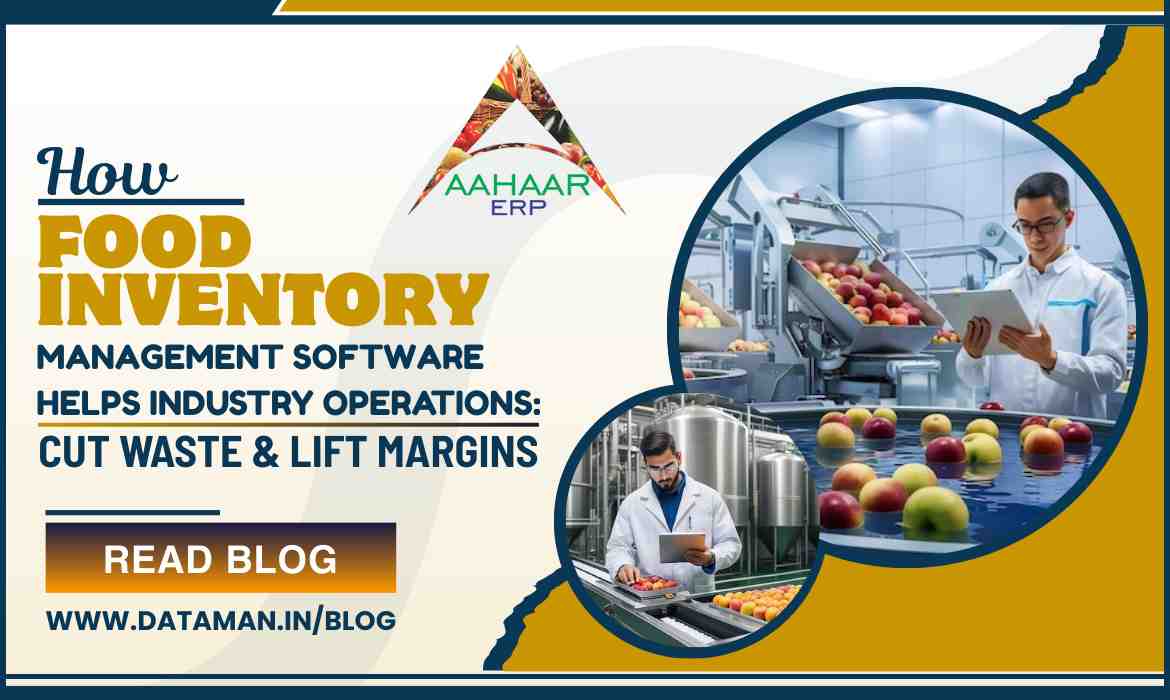
Table of Contents
Post Views: 9,556
In 2025, maintaining a profitable food business requires cost control, waste reduction, and responsiveness to real-time stock data. That’s exactly how food inventory management software helps restaurants and food industry operations deliver better profit growth and customer experience. Restaurants and F&B companies are turning stock control into a competitive advantage with features like AI-driven forecasting, expiry tracking, and mobile stock updates.
Food companies that use inventory management software benefit from increased visibility, compliance readiness, and sustainable practices, as the worldwide inventory management software market expands at double-digit rates. This demonstrates how inventory management software keeps food sector operations competitive.
This article explores how food inventory management software helps food industry operations cut waste, boost margins, and stay competitive.

2025 Trends That Make Inventory Software Non‑Negotiable
The market for inventory management software is expected to increase across industries, including food and beverage, from its estimated USD 2.38–3.17 billion in 2025 to USD 8.48 billion by 2035 (13.1% CAGR) or USD 4.78 billion by 2030 (8.56% CAGR).
- The Urgency of Food Waste: Food waste is still a major problem; according to UNEP’s 2025 study, homes alone waste 631 million tonnes of food per day, or more than one billion meals. This underscores the necessity of demand forecasting and expiry tracking in the food and beverage industry.
- Shift to Real-Time Systems: Industry practice is shifting to real-time, AI-assisted, mobile-first stock systems in 2025. These platforms offer on-the-go dashboards, automated ordering, and predictive analytics, key components of modern restaurant inventory best practices.
AI-Powered Insights: AI inventory forecasting is now a standard feature, enabling companies to anticipate demand with previously unheard-of precision, hence minimizing stockouts and overstocking.

Where Food Operations Lose Time and Margin
- Without batch/lot and tracking, spoilage and expiry loss quickly turn perishable goods into a sunk expense.
- Stockouts and overordering are brought on by manual counts and spreadsheet errors, which affect menu availability and customer satisfaction.
- Without automated logs and warnings, compliance paperwork for audits (temperature, traceability, and allergy control) takes a lot of effort.
Core Benefits of Food Inventory Management Software

Modern platforms show how inventory management software aids operations in the food business.
- Reduce Waste and Spoilage: Demand-based ordering, automated expiry notifications, and FEFO-based usage that helps to cut food waste by up to 50% in some establishments.
- Real-Time Visibility: Teams can quickly monitor inventory in stores, dark kitchens, and warehouses with the use of live dashboards on mobile devices.
- Planning and Forecasting: AI systems forecast ingredient requirements by campaign, weekday, and season, reducing working capital.
- Cost control and margin uplift: Gross margins are enhanced by reduced variation, fewer last-minute purchases, and better vendor ordering. A well-implemented system can improve food cost margins by 2–5%.
- Compliance and Traceability: Recall readiness, batch/lot history, and automated logs make audits easier and lower risk.
Speed and Efficiency: Vendor reconciliations, digital purchase orders, and automated counts save hours per week across all locations.
Common Problems vs Software Outcomes
There are many problems that the food and beverage industry faces, by adopting an inventory management software can help provide a solution for these problems.
| Common Problem | Impact | Software Outcome |
|---|---|---|
| Unmonitored expiries | Waste of stocks | FEFO, expiry alerts, and batch tracking reduce wastage |
| Manual inventory counts | Errors and variations | Real-time synchronization and mobile counts minimize disparities. |
| Services with stockouts | Lost sales, poor CX | Stockouts are avoided with auto-reorder and low-stock notifications. |
| Over-ordering | Cash tied up | Orders and demand are in line. |
| Compliance burden | Employee time and audit risk | Audits are managed by digital logs, traceability, and recall readiness. |
Key features to look in food Inventory management software in 2025

When selecting food inventory management software, prioritize these essential features:
AI Forecasting and PAR Automation:
Forecast demand by daypart, outlet, and SKU; automatically create purchase orders to reach optimal PAR levels.
Batch, Lot, and FEFO Controls:
For perishable accuracy, track by lot and make sure that first-in, first-out applies.
Price and vendor intelligence:
Standardize buy units, monitor delivery deviation, and compare supplier prices.
Cycle counts and mobile dashboards:
Use rapid counts and deviation reviews to facilitate accountability at the shift level.
Integrations:
POS ( Point of Sale), accounting, WMS ( Warehouse management system) / ERP (Enterprise resource planning), and e-commerce for a single source of truth and a unified data flow.
Toolkit for Compliance:
Temperature records, allergy alerts, traceability of recalls, and reports that are ready for an audit.
How Inventory Management Software Helps Food Industry Operations

Inventory management software helps various types of food industries, such as:
- Restaurants and Cloud Kitchens: Recipe costing, AI-powered POs, and daily mobile counts, stable food cost percentages.
- Bakeries and Confectionery: For flour, dairy, and fillings, FEFO and batch tracking reduce the chance of ingredient expiration.
- QSR and Franchise Networks: Centralized catalogues and vendor agreements ensure consistent pricing across all locations.
- Beverage and Bar: Margin protection is provided by real-time pour fluctuation monitoring and reorder triggers.
- Food Manufacturers: Customer trust and compliance are enhanced by recall readiness and lot traceability.
2025 Market Data of Food Inventory Management Software
| Market Trend | 2025 Insight | Business Impact |
|---|---|---|
| Market growth | USD 2.38B value; 13.1% CAGR to 2035 | Expanding innovation and accessibility for F&B operators |
| Alternative forecast | USD 3.17B in 2025; 8.56% CAGR to 2030 | Consistent multi-year growth validates adoption |
| Waste urgency | 631M tonnes of household waste in 2024 | Strengthens the ROI case for expiry and demand control |
| Tech adoption | AI, mobile dashboards trending in 2025 | Real-time visibility reduces variance and stockouts |
Features And Their Outcome
| Feature | Operational outcome | Financial outcome |
|---|---|---|
| AI forecasting | Right-time ordering, fewer runouts | Lower waste, optimized working capital |
| FEFO tracking | Less expiry loss | Margin protection |
| Recipe costing | Stable plate costs | Predictable food cost % |
| Vendor analytics | Price control, on-time delivery | Reduced COGS volatility |
| Mobile counts | Lower variance | Fewer write-offs |
| Compliance logs | Faster audits | Lower risk costs |
Conclusion: Turn Inventory Into Advantage
Due to growing expenses and ongoing waste issues, inventory management software is essential for operationalizing inventory to reduce losses, increase profits, and maintain compliance in the food sector. To meet audit and sustainability requirements and match purchases with demand, real-time control over outlets and menus is created using AI, mobile dashboards, and linked workflows.
This is how food Inventory management software helps food sector operations to win in 2025 and beyond. Operators who standardize catalogues, apply FEFO, and automate replenishment will outperform on waste, cost, and customer experience as market adoption rises through 2030–2035.
FAQ: Frequently asked questions
1. What is food inventory management software used for?
To avoid stockouts and overstocking while cutting expenses, inventory management software is used to maintain stock, automate reordering, manage orders and fulfillment, and provide real-time visibility across locations.
2. What is an inventory management software system?
An automated software program called inventory management software is used in businesses to simplify a variety of stock control and order management duties.
3. Does food inventory management software reduce food?
Yes, expiry tracking, FEFO, and predictive ordering directly cut spoilage.
4. What are the 4 types of inventory management?
Raw materials, work-in-progress (WIP), finished goods, and maintenance, repair, and operations (MRO) inventory are the four categories of inventory.
5. How does inventory management software manage demand forecasting?
By combining historical sales, seasonality, promotions, external factors (weather, holidays), and real-time POS data, we can generate SKU-level predictions that continuously self-improve with machine learning.
0
 25/16 Karachi Khana, Kanpur
