- +91 9511117684
- shweta@dataman.in
Why ERP Software Will Drive Growth And Efficiency In Food & Beverage Industry In 2025
Table of Contents
Post Views: 6,410
In today’s fast world, the food and beverage industry is growing, with challenges from supply chain problems to meeting consumer expectations. Managing everything manually in outdated ways can slow down the market. ERP Software (enterprise resource planning) tool is the best solution for this problem because ERP nowadays is a must-have rather than just being helpful.
In this article, we will discuss why the food and beverage industry needs ERP solutions and what challenges it faces while implementing them.
What is ERP Software?
Before knowing the industry benefits, knowing what ERP Software is is crucial. The organisation uses an ERP tool for various purposes, including finance, manufacturing, supply chain management, services, procurement, sales, and many more in one platform.
Why is it important for food and beverage operations?
Instead of using old traditional methods, nowadays businesses are using one dashboard to manage and operate all operations on one platform efficiently. The smooth integration is important for the speed and accuracy required in food production and distribution.
How does ERP work for the food sector?
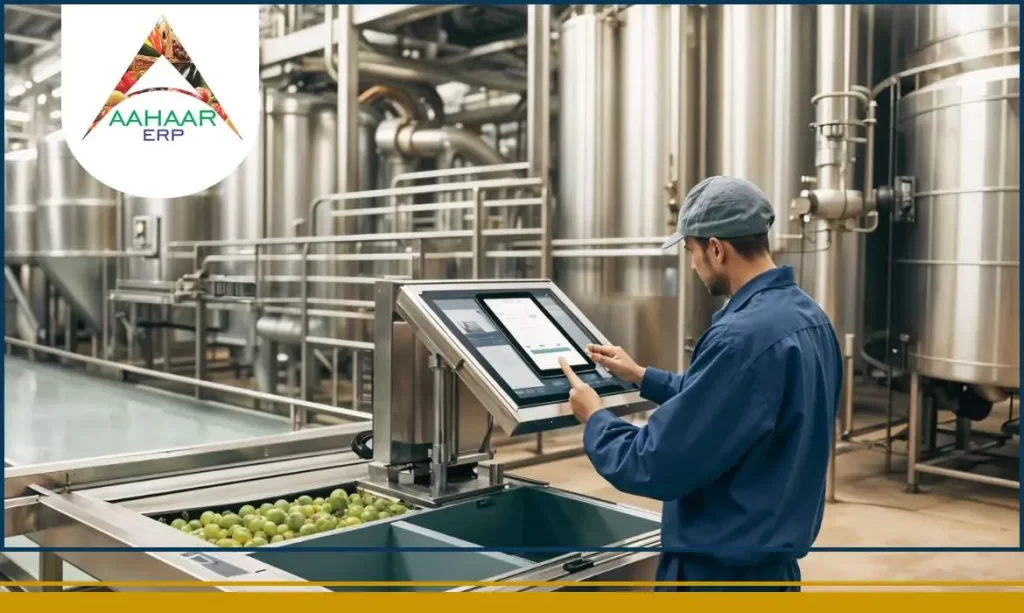
Operations like inventory management, finance, sales, procurement, and billing, ERP systems efficiently manage it all. This type of system is generally used by the food and beverage sector, which requires fast management, accurate tracking, quality controls, stock management, etc.

Manual To Digital Transformation
Long ago, all the operations were run on spreadsheets, paper, as the food industry came and developed into modern traditions of business, here is how the management has changed. Nowadays, businesses are driven by digital transformation through the adoption of enterprise resource planning platforms.
| Operations/Working | Traditional Systems | ERP Systems |
|---|---|---|
| Stock Management | Manually on paper with spreadsheets and registers | Real-time management, with accurate insights |
| Billing | Paper-based billing may sometimes have errors in calculation. | Accurate calculations with digital invoicing and no errors. |
| Product Tracking | No such option is available in manual systems | Exact product tracking from raw to dispatch, everything on the record. |
| Decision Making | In a manual system, decisions are only based on guesswork and old transactions. | In an ERP system, a decision is derived after checking the real-time data tracking and insights provided. |
| Speed | Slow, and it depends on humans working | Fast and, specifically, accurate |
Why is the demand for ERP software in the food and beverage industry rising?
The demand in the food and beverage sector is rising due to the following reasons:
- Increase in demand: As the demand grows up business needs fast and accurate systems to scale up.
- Consumer satisfaction: Today’s customers need a high-quality product, clear information, and safety standards; this is where ERP helps.
- Rise in competition: High demands lead to high competition too, ERP tools help to be ahead of the competitors.
- Real-time data-driven insights: Data is the most important part of any business nowadays, where ERP provides the real-time data for businesses through which they work.
ERP software for food mills:
When the food industry integrates with ERP software, it gets a wide range of access to services, which helps them to manage operations, compliance, and boost productivity.
Here are the services that are specially designed for flour mills, rice mills and and similar processing units.
- Raw material management
- Mill process control
- Storage and stock management
- Quality assurance
- Waste control
- Cost optimization
Why ERP Software Is a Necessity for the Food and Beverage Industry?
Let’s break down the main reasons why an ERP solution in the F&B sector has become a necessity for the food and beverage industry.
| S. No. | Category | Key Features |
|---|---|---|
| 1 | Inventory Control |
|
| 2 | Food Safety And Regulatory Compliance |
|
| 3 | Cost And Waste Reduction |
|
| 4 | Multi-order Management |
|
| 5 | Automation Planning |
|

Challenges of ERP implementation in the food industry
Besides having merit, ERP software also has some basic limitations, like every software.
- High costs, especially for small businesses.
- Staff need training to learn the features of the software.
- It may need customization, and time taken to learn all about the software.
- Needs to be updated as per the trends.
Practical Steps before implementing the ERP software
There are certain steps before integrating an ERP software. Here are the points that need to be considered while implementing:
- Know how much your business needs, don’t overbuy
- Select a specific industry-specific ERP; a General ERP may lack some features
- Let your employees know about the software before implementation
- Avoid full implementation at once
- Monitor and improve the data continuously
Myths About ERP Software in the Industry
Many food businesses have confusion about adopting ERP software due to misconceptions.
| MYTHS | REALITY |
|---|---|
| ERP is only for big businesses | ERP systems now provide services to small and mid-cap businesses. |
| ERP is too costly | Long-term wastage, labour costs, and error reduction outweigh the cost. |
| Implementation is tough | With proper training and guidance, implementation can be made easy. |
| My current system is more than enough | Outdated systems may be inefficient. Updated software provides more accurate and real-time insights. |

Conclusion
In 2025, Enterprise Resource Planning (ERP) is not only an option, it’s a necessity for every food and beverage industry. From procurement to sales and customer satisfaction, it handles all major aspects that cannot be fulfilled manually, when it comes to long-term returns, difficulties, efficiency, accuracy, and growth, ERP outweighs all these.
Nowadays, this industry is looking forward to staying on trend, competitive, and consumer-focused in 2025; that’s why adopting an ERP system is no longer optional, it is essential.
Frequently Asked Questions
What is the food and beverage industry?
The food and beverage industry is about getting food and drinks from raw form to the table. Everything from making, packaging, and distributing comes from this industry.
What is ERP in the food industry?
The term “enterprise resource planning” in the food sector describes a specific software program created to oversee and maximize each of a food and beverage company’s primary business operations.
What is ERP, and its benefits?
ERP (Enterprise Resource Planning) is a software program that unifies and combines all of the main business operations from different departments, such as sales, manufacturing, finance, and human resources.
What is the trend in F&B industry?
Veganism and vegetarianism are popular right now. Therefore, you must always offer plant-based dishes on your menu if you want your F&B business to be successful.
How many types of F&B industries are there?
The following are the primary categories of commercial general market establishments: hotels, eateries, bars, snack bars, fast food, and takeout.
What is the digital transformation in FMCG?
The production, distribution, and delivery of consumer goods are being completely transformed by the digital transformation of the FMCG supply chain.
0
 25/16 Karachi Khana, Kanpur