- +91 9511117684
- shweta@dataman.in
POS System in Apparel Industry: How Fashion Retailers Can Boost Sales, Inventory Accuracy, and Omnichannel Growth

Table of Contents
Post Views: 4,966
In 2025, the apparel business is not only about selling clothes, it’s about delivering the best omnichannel experience to customers. From browsing online to pickup in store, or swapping sizes across multiple locations, apparel businesses face multiple challenges that demand efficiency, speed & accuracy. This is where the POS system in the apparel industry becomes a game-changer.
According to recent predictions, click-and-collect (BOPIS) sales in the United States are expected to reach over $150 billion this year alone. Modern point-of-sale (POS) systems, which manage returns and exchanges, integrate online and physical inventories, and allow businesses to provide individualized shopping experiences, are responsible for this increase.
This article will assist you in selecting the best point-of-sale (POS) system for clothes retailers, regardless of the size of your business. It will increase both efficiency and profitability.
What Is a POS System in the Apparel Industry?

A POS system in the clothing industry software is not just a cash register; it’s the backbone of all the retail operations that ensures reliability and accuracy for the business. It consists of the following particulars:
- Billing and checkout
- Management of product catalogues (including changes in size, colour, and style)
- RFID and barcode-based scanning
- Rebates, sales, and loyalty initiatives
- Exchanges and returns
- Combined analytics and reporting
E-commerce and physical retail are also integrated by modern point-of-sale software. Real-time stock level synchronization allows for omnichannel features like:
- Buy Online, Pick Up In Store (BOPIS)
- From-store shipping
- Channel-wide unified refunds and exchanges
- Customer history tracking for customization
For multi-location apparel retailers, the right POS system acts as a centralized retail management system that cuts costs and enhances decision-making.
Key Benefits of Using POS in Fashion Retail

Adaptation of a specialized pos system in the clothing industry provides several benefits that directly impact business revenue and customer satisfaction.
1. Inventory Management in Real Time
- Monitor inventory across stores and warehouses at the SKU level.
- Avoid stockouts and overstocking by receiving low-stock alerts.
2. Reduced Errors & Quicker Checkout
- Digital receipts and barcode/RFID scanning help to minimize billing errors.
- During peak hours, mobile point-of-sale solutions expedite lines.
3. Easier Returns and Exchanges
- Size and colour changes are possible with apparel POS without compromising inventory control.
4. Combined Profiles of Customers
- Keep track of preferences, past purchases, and loyalty to implement tailored promos.
5. Multichannel Satisfaction
- Allow click-and-collect, same-day delivery, and online returns in-store.
6. Data-Informed Retailing
- Utilize analytics to track markdowns, product performance, and sell-through rates.
7. Scalability of Multiple Stores
- Centrally manage pricing, promotions, and catalogues for all of your stores.
Why the Apparel Industry Needs a Modern POS System

Like other retail businesses, clothing businesses also face many kinds of challenges, such as:
- Each product has several sizes, colours, and SKUs.
- Fashion trends are changing quickly.
- Demand spikes that occur seasonally.
- Online marketplaces are becoming more competitive.
Traditional billing systems cannot manage these kinds of challenges. By not adopting a modern POS system in the apparel industry, the business faces:
- Slow checkout queues
- Mismatches in inventory
- Sales are lost as a result of stockouts
- Ineffective handling of returns and exchanges
Real-time visibility, speedy checkouts, and consistent consumer experiences across channels are all guaranteed by a point-of-sale system in the retail apparel industry.
Must-Have Features of an Apparel POS
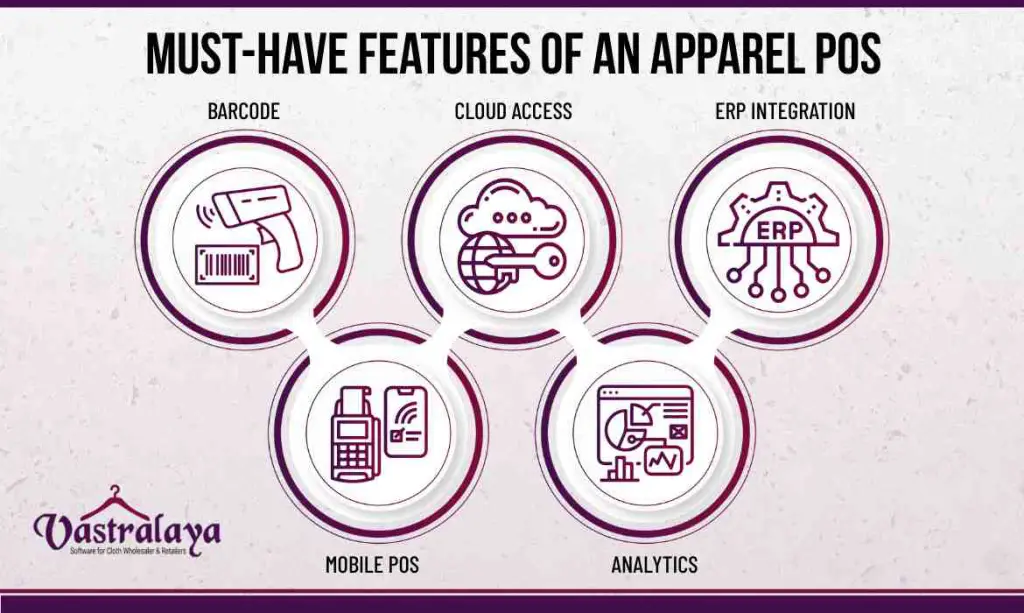
While choosing a POS software for fashion retail, a business should look for these features:
- Integration of barcodes and RFID for precise inventory control.
- Support for many stores with centralized catalogue management.
- Cloud-based administration access from any location at any time.
- Inventory synchronization between online and offline sales in real time.
- Connectivity with ERP and accounting applications.
- Options for mobile point of sale to help in-store employees.
How POS Improves Customer Experience in Fashion Retail
A POS system not only works with business transactions, but it also manages and enhances customer satisfaction by:
- Providing tailored promos according to past purchases.
- Supporting gift cards and loyalty schemes.
- Using QR codes and digital wallets to enable quicker checkouts.
- Enabling smooth returns and swaps between channels.
A point-of-sale system guarantees that shops meet the expectations of over 70% of consumers, who demand a consistent omnichannel experience.
Trends in Apparel POS Systems for 2025 and Beyond
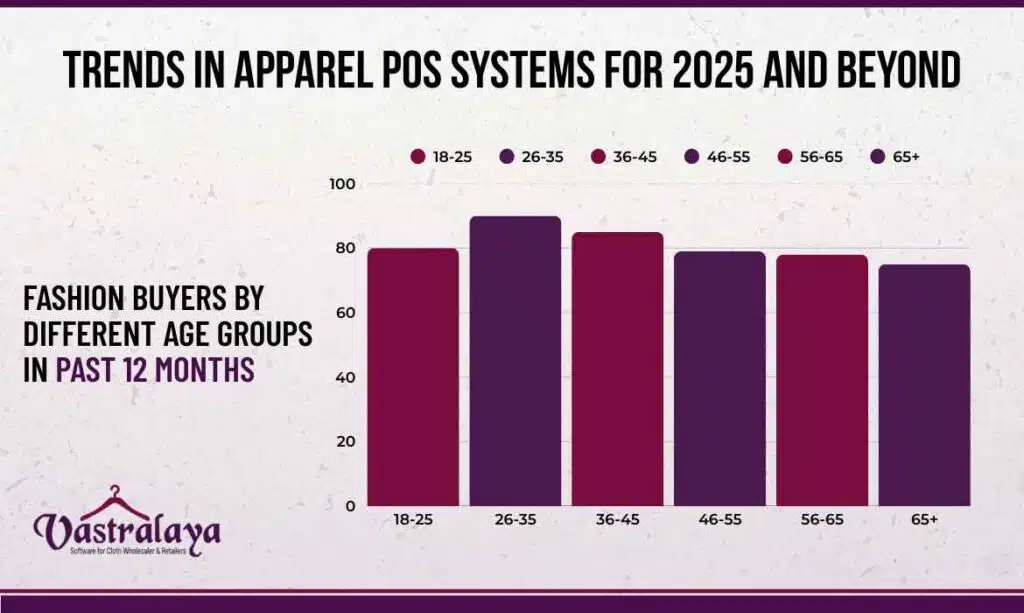
Fashion buyers by different age groups
Nowadays, fashion retail POS is rapidly evolving according to the trends and demands of the market:
- Remote access to cloud-based point-of-sale systems.
- Analytics driven by AI to forecast demand for size and style.
- Employees using mobile point-of-sale devices to help consumers on the shop floor.
- E-commerce integration.
- For a quicker checkout, use contactless payments and QR billing.
POS System for Boutiques vs Large Retail Chains
Generally, every business nowadays needs a POS system, whether it’s a small retail boutique or a large-scale business. The POS requirements of boutiques differ from large apparel retailers.
| Business Type | POS System Priority | Example Features |
|---|---|---|
| Apparel Boutiques | Easy-to-use, affordable | Barcode scanning, loyalty programs, and simple reporting |
| Fashion Retail Chains | Scalability, central control | Multi-store management, ERP integration, and advanced analytics |
Challenges Without a POS System in Apparel Retail
Several challenges are often faced by retailers without a modern POS system:
- Mismatches in inventory that result in missed sales
- Customers are irritated with slow checkout times.
- Having trouble handling returns and exchanges
- Insufficient sales data to inform merchandising choices
- Absence of omnichannel capabilities
How to Choose the Best POS System in the Apparel Industry

Before choosing a POS system, a business must ensure a long-term ROI before implementing it in the business.
| Feature Category | Must Have Particulars |
|---|---|
| Inventory Management | Variant tracking, low-stock notifications, and real-time stock updates |
| Checkouts & Payments | Splitting bills, barcode scanning, and contactless/mobile assistance |
| Omnichannel Support | Unified client data and online/offline synchronization |
| Analytics & Reporting | Demand forecasting, top-selling SKUs, and sales trends |
| Scalability & Integrations | Integrations of marketing, accounting, CRM, and ERP software |
| Usability & Training | Mobile POS apps, staff training, and an intuitive user interface |
ROI of Implementing a POS System in Apparel Retail
Investing in a POS system is not just a cost for the business, but it’s a creative profit driver for the business, which helps to profit in multiple scenarios, such as:
- Cut inventory losses by as much as 30%.
- Increase sales income through upselling and marketing.
- Automated reporting can save time.
- Boost CLV (client lifetime value) by personalizing
Future of POS in Fashion Retail
Before implementing a POS system in the business, there is a mindset for which it has been implemented. The future of the POS system in the apparel industry lies in:
- AI-powered customization (making recommendations for colours, sizes, and styles).
- Inventory tracking with RFID.
- smooth omnichannel integration of social media, web, and physical business.
- Mobile-first point-of-sale systems for employees and clients.

Market size of the clothing sector
In the fiercely competitive fashion industry, retailers who use these advances will maintain their lead.
Conclusion
The clothing industry is fiercely competitive, fast-paced, and influenced by trends. To remain relevant, shops want a point-of-sale system specifically designed for fashion enterprises, rather than merely a billing solution.

United States apparel market size
In this context:
- In 2025, click-and-collect sales in the US are predicted to reach $154.3 billion, representing a 16.2% annual growth. SOURCE
- By the end of 2025, the market for mobile point-of-sale (POS) is anticipated to reach $55 billion, with 85% of mid-size U.S. shops anticipated to use it. SOURCE
- Profitability can be increased by up to 25% by utilizing advanced analytics, while inventory markdowns and overstock can be decreased by up to 50% by integrating POS with RFID. SOURCE
These figures demonstrate that a contemporary point-of-sale system is a strategic growth lever rather than just a tool. Fashion businesses may enhance customer satisfaction and long-term business value by using a point-of-sale (POS) system, which also facilitates omnichannel operations and boosts profitability.
Ready to Transform Your Apparel Business? Get a free demo now.
FAQ ( Frequently Asked Questions )
1. What are the four types of POS systems?
POS systems come in four primary varieties: cloud-based, mobile, tablet-based, and legacy.
2. What does POS mean in clothing?
Retailers use clothes point-of-sale (POS) systems to run their stores. Retail employees can use it to accept payments, track client information, manage inventory, ring up orders, and create sales reports.
3. Is POS a CRM tool?
They serve distinct purposes: CRM is your customer connection engine, whereas POS is your sales and transaction engine. The best course of action would depend on your retail store’s particular requirements.
4. What are the six functions of POS?
The six main functions of a point-of-sale system include :
- buying, selling, renting, and repairing.
- Inventory control.
- Order management for suppliers and customers.
- Purchasing from a single supplier.
- Reports that are both consistent and customizable.
- Managing many stores.
5. What are the three CRM tools?
Operational, collaborative, and analytical CRM systems are the three primary categories of CRM software.
6. What are the 5 types of transactions that may be recorded using a POS system?
Among the primary kinds are:
- Cash, credit/debit cards, and contactless payments are all accepted in person.
- Online POS transactions include mobile ticketing and e-commerce purchases.
- Mobile point-of-sale transactions: self-service kiosks and tablet-based checkouts.
- Auto-billing and membership subscriptions are examples of recurring POS transactions.
1
 25/16 Karachi Khana, Kanpur